Once upon a time, I worked as an in-house designer exclusively with one sales team. I was invited to frequent customer events or encouraged to fill a seat and chat once I was done handing out name tags, and I always prepped the same way – by watching Sports Center. Sports is the great equalizer, and there is no more watched sport in the United States than football.
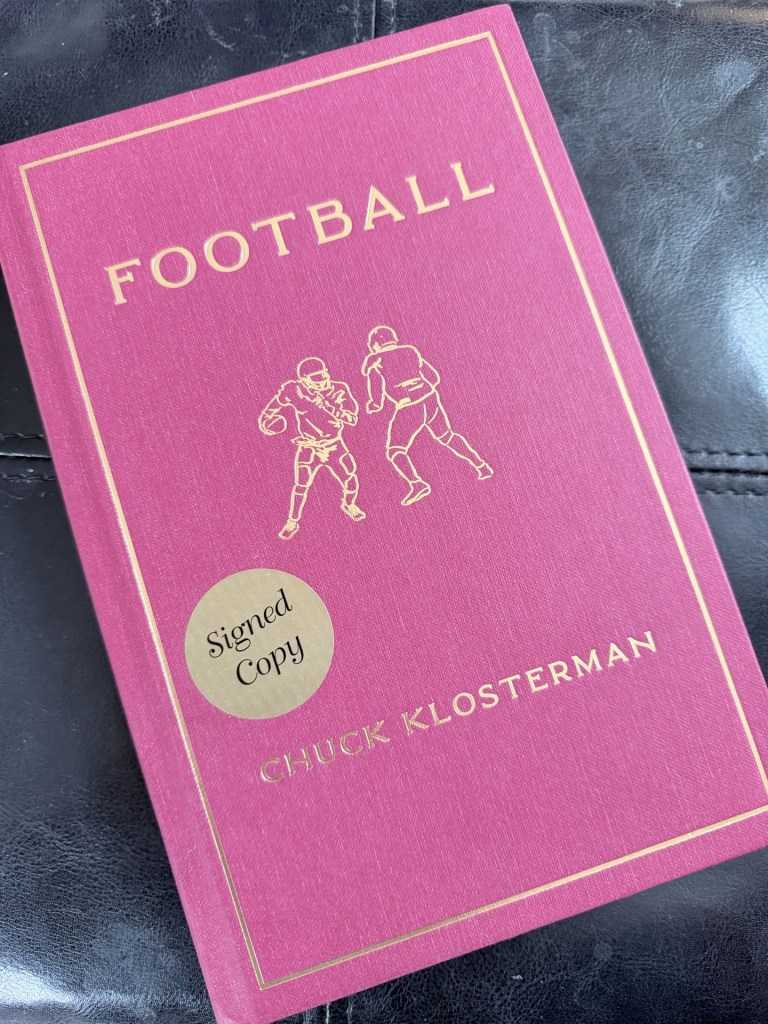
Klosterman is a lifelong football fan. Growing up in rural North Dakota, the game was something he shared with his older brothers and his father. While he explores his personal connections to the game, his larger point is that the complexity and incoherence of the game make it uniquely American. He also thinks that football is, right now, at its peak in terms of popularity.
Complexity. Klosterman notes that football is nearly impossible to play recreationally. It requires a unique set of physical skills and extensive complexity. It is undemocratic and exclusionary, and this also makes it special.
Television. “Football is a purely mediated experience, even when there is no media involved.” Television mediates it as do the legions of sports commentators that dissect its extensive rules, fill in on coaching changes and locker room drama, and speculate on the league’s extensive injuries. (More on that later.) Sirius XM has an entire station developed for the NFL, and it plays all year long even outside the league’s regular season. It’s one sport that is undeniably better on television with the game existing IRL just to be broadcast.
Action. Most sports are about action, but football has little of it. The average game contains just 11 minutes of actual football, and the best of those 11 minutes will get rehashed on ESPN so you can follow the conversation at your next banquet. Football dominates television because the latter amplifies the best aspects of it and reduces its flaws.
Freedom. Football flourishes by making everything scripted. SEE above TV. Every play is managed and officiated. The sport has become MORE rule based over time with new rules added every year.
GOAT. Klosterman spends some time comparing football players from different eras and while comparison is difficult, he settled on Jim Thorpe, who no one has seen play as there is no footage of him playing. A multi-talented athlete and Olympian, Thorpe worked out by doing farm labor.
Simulation. Football, as a whole, has improved, which also means that players have improved. Part of that improvement is film, lots of it. Starting with VHS, football games are filmed and studied, and with video games, they are also obsessively played in simulation. Enter fantasy, and you can “play” football from anywhere. It’s a video with no controller. Feel like wagering? Try sports gambling, which, Klosterman notes, is also addictive.
Race. Minorities are actually overrepresented in the NFL as a percentage of the population. Some groups, like Samoans, are widely overrepresented, but the topic is still taboo depending on who is talking about it. Klosterman points to Kaepernick, “Kap sacrificed a potentially long career as a backup or marginal starter, in service of an unpopular political message that became common opinion within four years. The impact of this exceeds almost anything he could have accomplished as a player.”
CTE. “Either people should be allowed to do dangerous things, or people should not.”
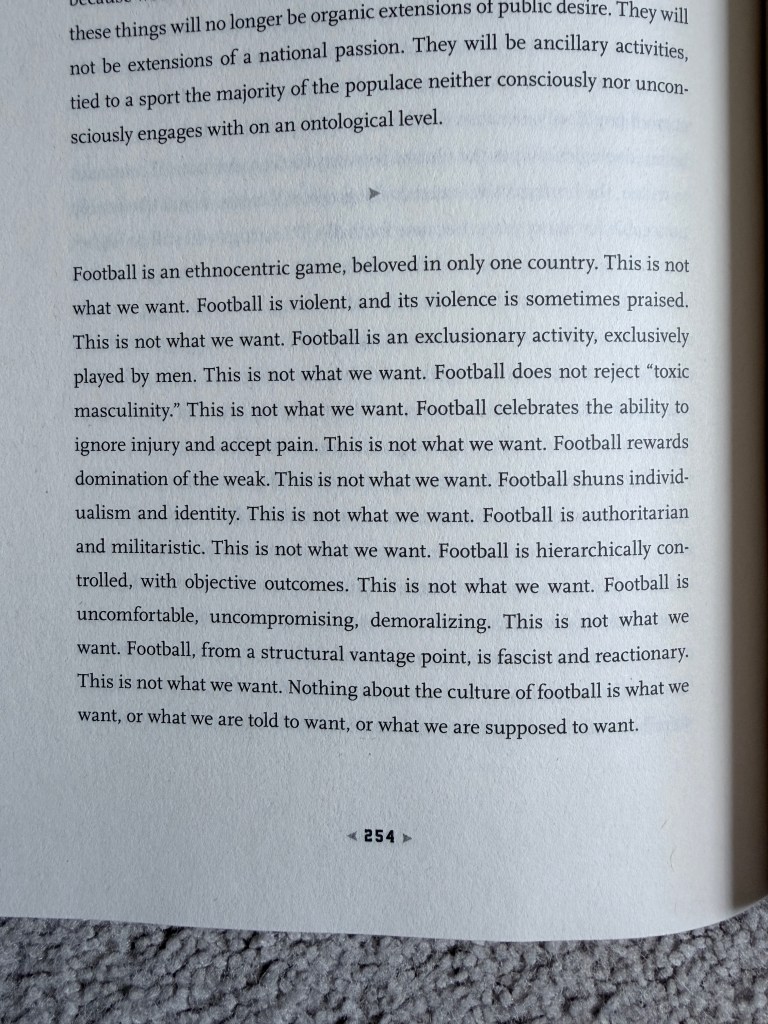
Fin. Football will become less popular for some of the same reasons horse racing is no longer popular. “Horse racing receded from prominence when average people lost their relationship to horses.” Once football becomes divorced from culture, it will no longer be popular. “Nothing about the culture of football is what we want, or what we are told to want, or what we are supposed to want.” It is too unstable to exist when everything around it changes.