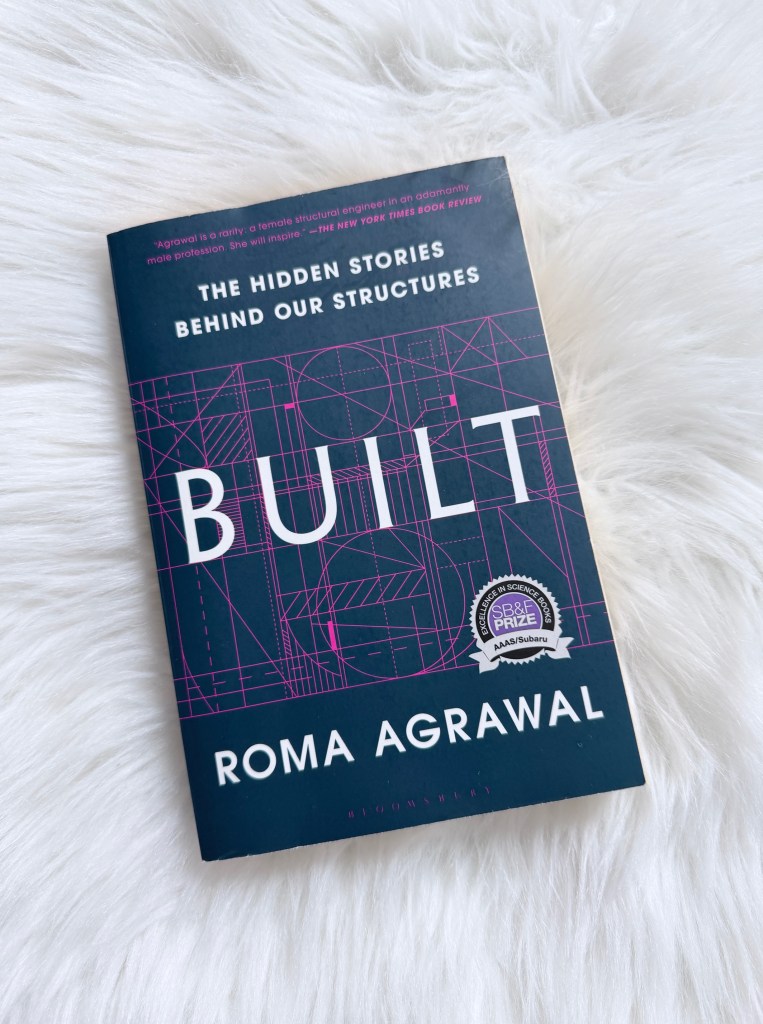
By Roma Agrawal
I got this lovely book at Rediscovered Books in Boise, Idaho, but to be fair, I had also seen it in the Tate Modern’s bookshop. Agrawal is a British architect, and so many of her examples are from the UK, which adds to the appeal of the book for me.
The book is divided into different building materials and concepts with numerous really good examples of how structures need to be made for the elements and for the unexpected, like fire. An early 60s apartment fire in London and, of course, 9-11 make good cases for the impact of fire on large structures. The Twin Towers had been tested for a plane impact but of a smaller plane and without the impact of so much fuel onboard. In fact, architects build scale models of their final designs and test them against weather – wind and earthquakes in particular – before they are built.
Concrete is a Roman invention and the early builders were starting to understand force and gravity and could build larger structures. Really large buildings wouldn’t be built until the invention of the elevator in the mid 19th century.
Tall buildings also have to accommodate wind load at high altitudes and sometimes earthquakes, and Agrawal’s explanations of pendulum systems is intriguing. The systems like that of the Burj Khalifa, the world’s tallest building in Dubai, which utilizes a massive tuned mass damper near its top to counteract wind sway. Buildings in earthquake prone areas also utilize systems to reduce damage and counteract sway.
Brunel’s tunnel, which is also covered in Overground, Underground, is covered along with its inspiration, a wood boring worm that chews through the substance and uses its excrement to reinforce the tunnel it builds. Agrawal also covered famous Mexican cathedrals, which are built on shifting ground, and how they’ve been stabilized.
Agrawal clearly loves her profession and writes about it in a way that a mediocre student of math, like myself, might finally understand what all these calculations are for. There are stories in our structures and beauty in a well-executed design.