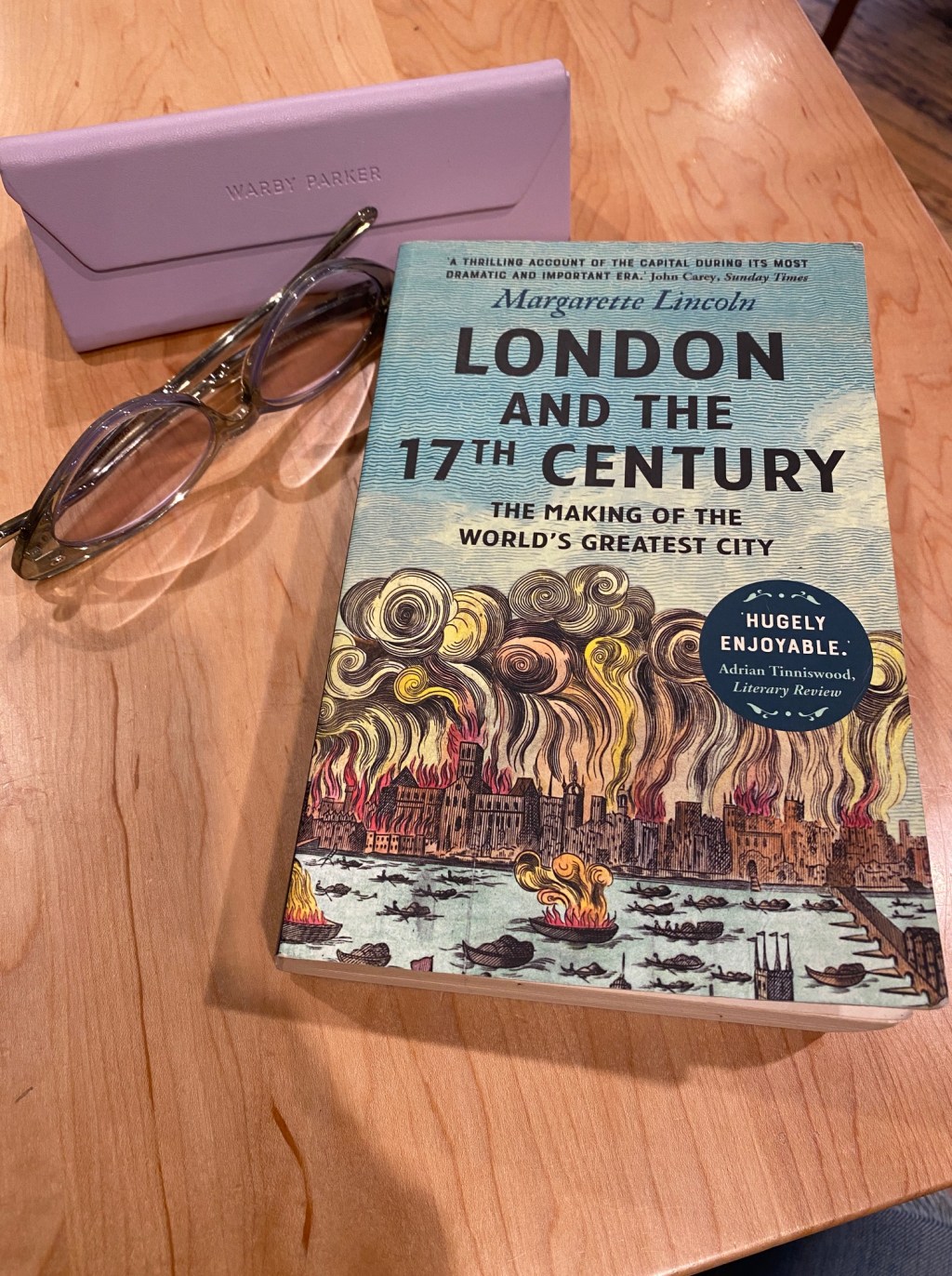
https://www.goodreads.com/book/show/54849809-london-and-the-seventeenth-century
I saw this book at Foyle’s on Charing Cross in London’s West End. I didn’t buy it then because my bag was already runneth over with books. The author makes the case that London became the city it is now in the 17th century in which the death of Elizabeth I is at one end and the death of Queen Mary at the other. There were wars, plagues, and a detour into a commonwealth in between.
The chapters are loosely chronological but also largely structured around larger concepts–building codes, ship building, trade, fashion, immigration. The 17th century was a time of war and plague and the Great Fire, which burnt about 80% of the walled city in the auspicious year of 1666.
For an American reader, the attachment to the monarchy was a curiosity, but I think what it might have meant is more of an attachment to convention and stability. For the freedoms gained under Cromwell and a commonwealth system weren’t evenly shared and didn’t come with the joie de vivre the public was used to with a monarchy – grand coronations, which even extended to the mayor, called Lord Mayor, funerals, and other functions. Those functions brought people together and were also a source of commerce for the various trades, whose organizing bodies known as livery companies, were quite powerful especially early in the century.
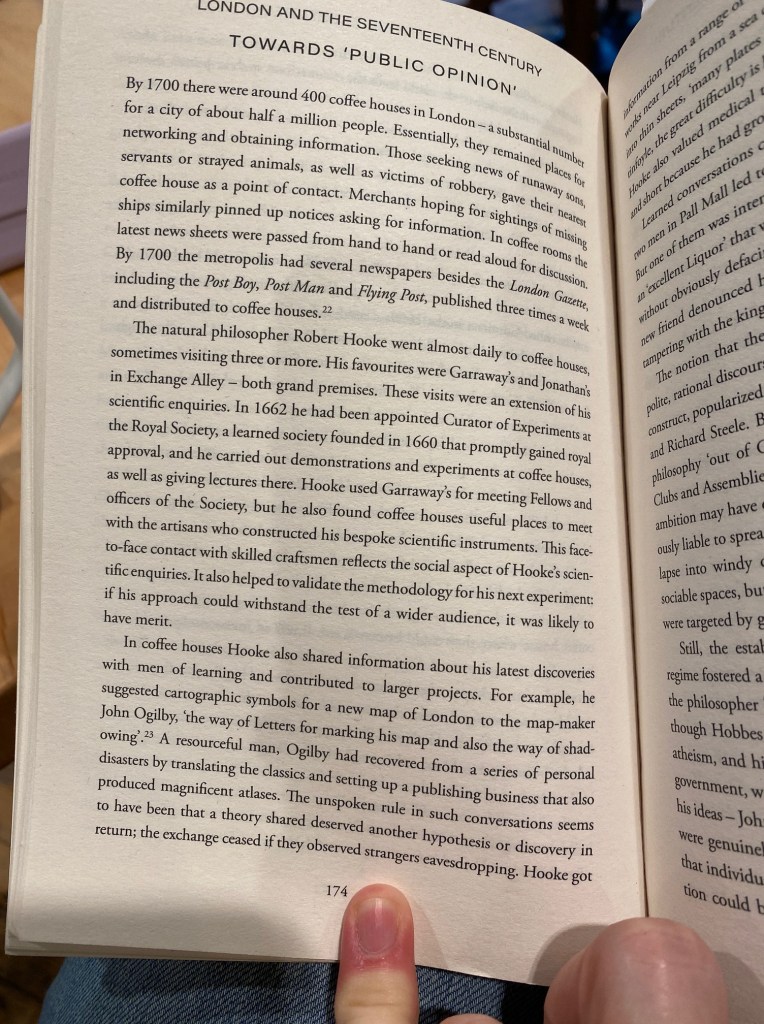
The power of community was also evident in the role of coffee houses as places to share ideas or, in some cases, plot revenge. These places and opportunities were upended during times of plague – both bubonic and smallpox. Londoners lost their collective minds at travel and congregation restrictions, which sounds so…familiar.
Naval power and trade were also features of this 100 year period starting early in the century with local ship building, to ship taking in times of war, and finally to expanded trade with the new American colonies along with fear, tariffs, and protectionism. Toward the end of the century, the country also established a central bank and began issuing more stable – read harder to counterfeit – currency under the direction of Isaac Newton. None of this would be possible without the attendant advances in science and mathematics, which aided shipbuilders in vessel design, improved optics, enhanced navigational techniques, and served to create credit markets and deficit spending.
Another clear theme was tolerance. Religious tolerance kept minorities from being a free part of society while religious prejudice abroad also drove large groups of Huguenots, French protestants who followed the teachings of John Calvin, to England about mid-century. They brought with them expertise in fabric design, weaving, jewelry and silversmithing, woodworking, decorative arts, and ballistics among other talents. Their contributions set up the country to compete on a global stage.
At just over 300 pages, this is a short primer on the history of the city that might lead you to deeper reading.
 Cher Time